Your batch is done.
Your report is already written.
Automated QC reporting for analytical laboratories. TerraPyxis takes raw instrument output and delivers a completed, audit-ready report for every batch. VCS, CCS, LCS, RPD%, matrix spikes, surrogate recovery: calculated, validated, and formatted without manual spreadsheet work.
Built for NATA-accredited analytical laboratories.
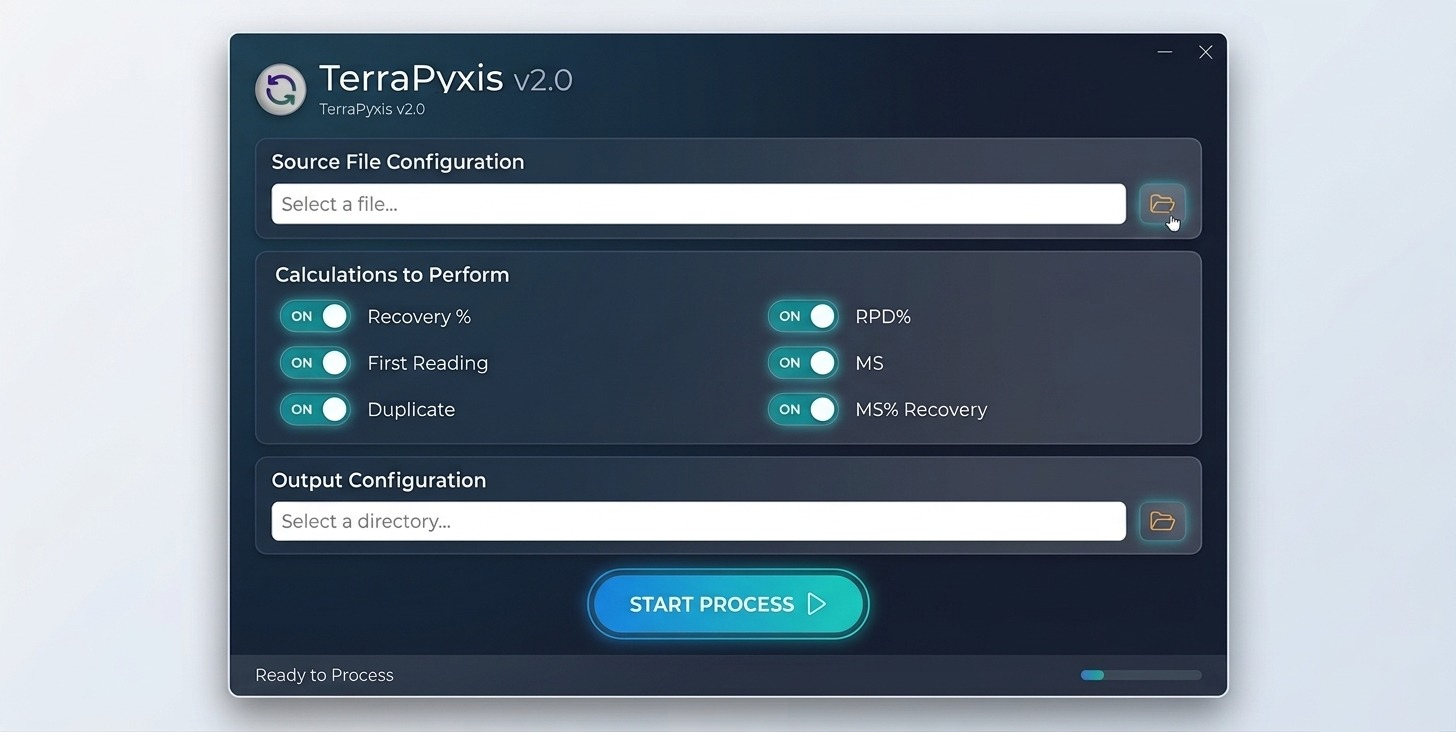
Scientifica replaced two days of spreadsheet work with a five-minute pipeline.
“Two full business days of spreadsheet work replaced with a five-minute automation pipeline. Zero transcription errors.”
Scientifica runs high-volume analytical testing across complex sample matrices. Their QC reporting workflow relied on interdependent spreadsheets: calculation logic distributed across multiple files, manual reconciliation between datasets, and approximately two business days per reporting cycle. TerraPyxis mapped Scientifica's full calculation logic, encoded their acceptance criteria, and deployed a purpose-built automation engine.
Scientifica's workflow is now a precision laboratory instrument.
Fragmented Logic
Calculation rules spread across multiple interdependent spreadsheets. Validation difficult. Change management risky.
Manual Reconciliation
~2 full business days per reporting cycle. Senior staff on data entry, not science.
Engineered Automation
Centralized calculation logic. Automated data ingestion. Intelligent mapping replaces manual reconciliation.
Operational Today
Modular architecture in production. New methods configured, not rebuilt. Under 5 minutes per cycle.
| Legacy Workflow | TerraPyxis Pipeline |
|---|---|
| ~2 business days per cycle | Under 5 minutes |
| Manual data reconciliation | Automated instrument-to-report mapping |
| Formula drift between file versions | Locked, governed calculation logic |
| Senior staff on data entry | Senior staff on science |
| Version conflicts across spreadsheets | Single source of truth |
From raw data to signed
report in three steps.
Ingest
TerraPyxis connects to your instrument output folders or LIMS database. Raw CSV, TXT, or XML data is ingested automatically as batches are completed.
Calculate
The engine applies your method-specific calculation logic. VCS recovery, RPD%, and moisture corrections are calculated in real-time against your defined acceptance criteria.
Report
A formatted, audit-ready PDF or Excel report is generated. Data is ready for technical review and signing immediately. No manual data entry required.
time per batch
What TerraPyxis is
(and what it isn't).
TerraPyxis is not a LIMS. It does not manage samples or track chain of custody.
LIMS implementations are broad laboratory management platforms. They typically cost $10K to $50K with a 3 to 9 month timeline to ROI. TerraPyxis is not a replacement for these systems.
TerraPyxis handles the reporting layer only: raw batch data in, completed QC report out.
Operational in days, not months. Configured to your methods before deployment. No broad platform. No unused modules. It works alongside your existing LIMS to solve the reporting bottleneck.
What TerraPyxis does.
Purpose-built for environmental, water, and chemical analytical testing laboratories.
Common questions from lab teams.
Technical details regarding deployment, security, and integration.
Is TerraPyxis a replacement for our LIMS?
No. TerraPyxis is a reporting layer that works alongside your LIMS. It handles the complex calculation and formatting tasks that most LIMS are not configured to perform, allowing you to automate the "last mile" of the reporting process.
How long does configuration take?
Most methods can be mapped and validated within 5 to 10 business days. Because TerraPyxis is modular, we can deploy one method at a time, allowing you to see operational ROI immediately without a broad platform rollout.
Does this meet NATA ISO 17025 requirements?
Yes. TerraPyxis maintains a full audit trail of all calculation logic and validation steps. Every report is generated using governed, version-controlled rules that meet the data integrity requirements of ISO 17025.
What instruments are supported?
We support any instrument capable of exporting data in structured formats such as CSV, TXT, or XML. This includes major platforms from Agilent, Shimadzu, Thermo Fisher, and others.
Talk to us about your lab.
We don't have a sales team. You will speak directly with the engineering team responsible for method configuration and deployment.
Opening your email client…
Your message has been prepared. If nothing opened, email us directly at the address below.
Average response time: < 24 hours.